
Physics As A Method
The Mechanism That Aims To Answer Age Old Questions

I’ve observed a recurring pattern in introductory courses. That is, in one way or another, they all seem to begin with philosophical questions. I’ve heard of Socratic introspection as the beginning of psychology, and in others, I’ve heard of rationalism as playing a part in the scientific method, along with systems of biological classification having their roots in Aristotle’s work. All of these concepts serve as examples of why I was not the least surprised as I come to understand that the discipline of Physics finds its most fundamental questions in Philosophy.

Ancient Superstition
Physics in ancient times was understood to be a part of natural philosophy, which is the philosophical study of nature and the physical universe. Questions like what things are made of, and whether we live in a geocentric, heliocentric universe, or neither, may ring a bell. Those were all questions belonging to the realm of natural philosophy. You might recall the early thinkers like Thales who proposed that the objects in our universe were composed of water, or, more precisely known today, H2O. There was also the famous proposition of Democritus, which formulated the universe as being composed of atoms, the word originating from the Greek word “Atomos”, meaning uncuttable.
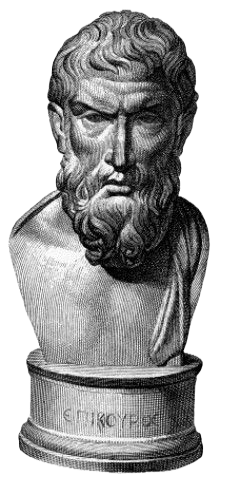
Later, after all of those science classes in my early education, I came to find out that the conception of the universe grew to be more sophisticated than I had thought it to be. This was made evident to me in Epicurus’ letter to Herodotus, as he highlights the way by which his empirical understanding led him to deduce a framework of reality that is not too far off from our own, especially taking into account that the conclusions were drawn through reason, rather than the polished scientific experimentation and equipment we have today. Funnily enough, I often tend to bring atomic swerve, which is the idea that atoms move in unpredictable ways into conversations of metaphysics and how movement is the cause of change, but that is an idea still in my mental workshop, and therefore one that I will speak about in later articles.
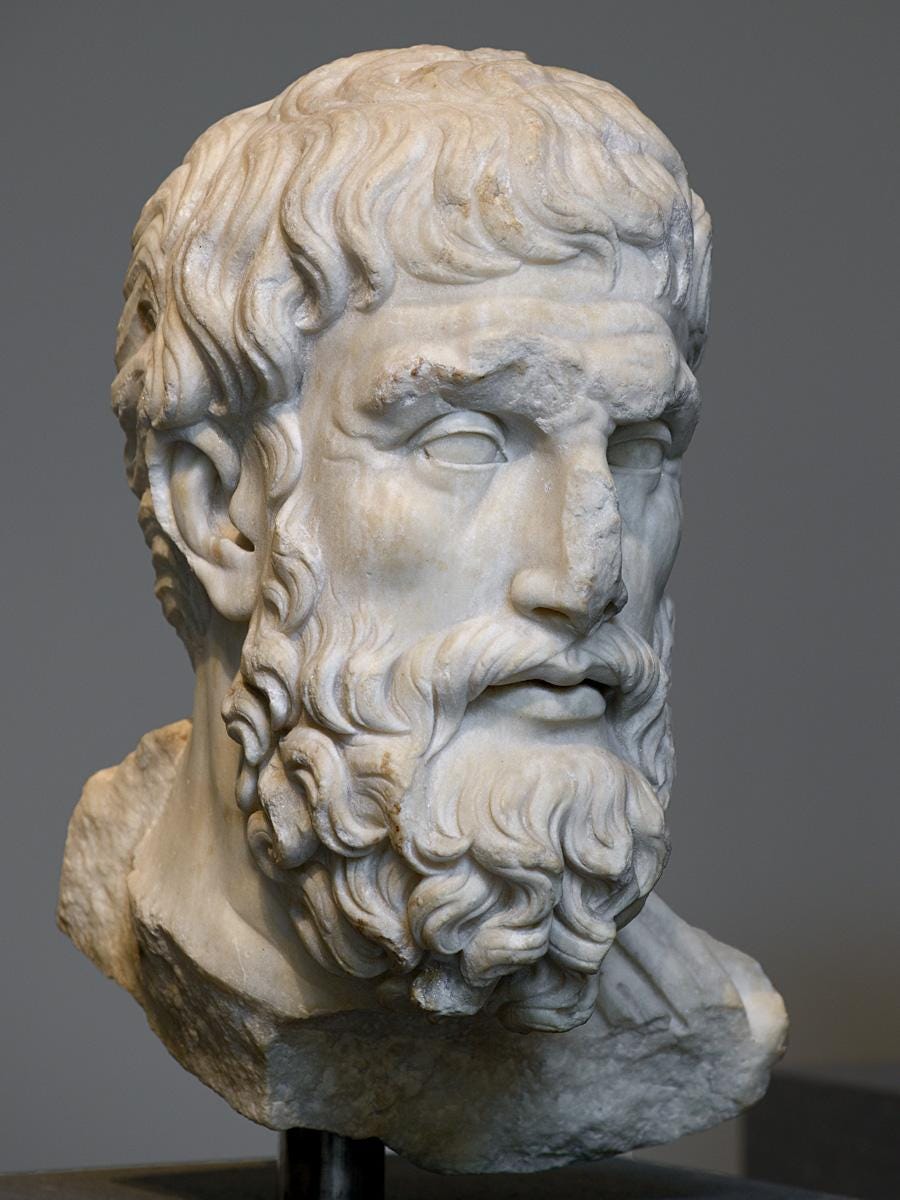
The Letter
When I first read this letter, three concepts stood out to me:
1) His explanation of matter not being created or destroyed, which mirrors today’s conservation laws. [3]
"Nothing comes into being out of what is non-existent. For in that case, anything would have arisen out of anything, standing as it would in no need of its proper germs. And if that which disappears had been destroyed and become non-existent, everything would have perished..."
2) The universe consisting of matter and space, or as he put it, “atoms and vacuum”, which he gives ontological reasoning that proposes movement as being possible because of space, and comes eerily close to modern physics in its explanation of space being a fundamental part of reality. [4]
"The whole of being consists of bodies and space. For the existence of bodies is everywhere attested by sense itself... and if there were no space (which we call also void and place and intangible nature), bodies would have nothing in which to be and through which to move..."
3) His proto-multiverse rationalization, which originated from the notion of atoms being of an infinite quantity, deduces a concept of many worlds. [9]
"Moreover, there is an infinite number of worlds, some like this world, others unlike it."
Surprisingly, he anticipates some of the most striking questions in modern theoretical physics, which ask: What does it mean to be outside of the universe? Moreover, can entities within it come to know it? I cannot deny that it is an impressive work that you should come to know.
What We Study Today
The study of matter and energy as the physics we know and love today did not begin to emerge until the scientific revolution and the rise of rationalism in the 17th century. The mathematical advancements of the 18th century led to classical mechanics through the increased use of the experimental method. Today, modern physics is still exploring the questions of the ancient world with the discovery of quantum mechanics. Quantum mechanics heavily depends on philosophical reasoning and critical thinking, as it requires you to abandon the classical intuition that has allowed you to make sense of the complexities of our world. Fields like theoretical physics blend philosophical rationalization with empirical findings and mathematical frameworks through cosmology, seeking to understand the very essence of our universe from its beginning to the course of its end. If you have ever entered the bizarre discussion of what happens to you when you enter a black hole, and what may be on the other side, then you are practicing the ancient art of natural philosophy through the lens of modern science.
Moving Forward
I have had many debates and discussions on the similarities and differences between science and philosophy. To me, they are the same question, yet they differ in method. In fact, I’d like to think that the emergence of rationalization and empiricism from philosophical thought makes science a component of philosophy. Although other scientists have differed in this view, it is evident that the love of wisdom and knowledge are concurrent parts of one whole, which suggests philosophy as a parent of science. In etymological terms, science simply means knowledge. I believe it is important to understand each framework, its strengths, and limitations, so that we can make better conclusions about our reality. Philosophy is the root of all questions, originating many fields as we keep discovering. Physics is the method by which we come to answer them.
One problem I find with substack is that it does not have an annotation feature. I also have aspirations of turning my articles into stylized magazine-like pages. This is the beginning of that, and I am hoping you will like it. All feedback is encouraged, so please do not hesitate to reach out. Contribute to the development of this publication, and thank you for believing in it as much as I do.

Sourcing and Recommended Reading
1) Epicurus. Letter to Herodotus.
2) Greene, Brian. The Elegant Universe.
3) Wikipedia. Outline of Physics
Receive new letters, reflections, and questions from the frontier of understanding.
Until Next Time,
— The Aletheian Conversing With the Cosmos.
I once heard a highlander interrupt a lecture on the cosmos with one question: but who turned the crank — physics has been describing the crank ever since.
Great read. In a way you also hint at some open questions. We still don't really understand gravity, for example. We know what it does and how it works, but that's it. I like to think about what came before the Big Bang, and when I see phycisists reach for an answer (mostly it ends with "Nobody knows") I wonder if that's a physics question or a philosophical one.